
InsomniaRisk presented the public experience
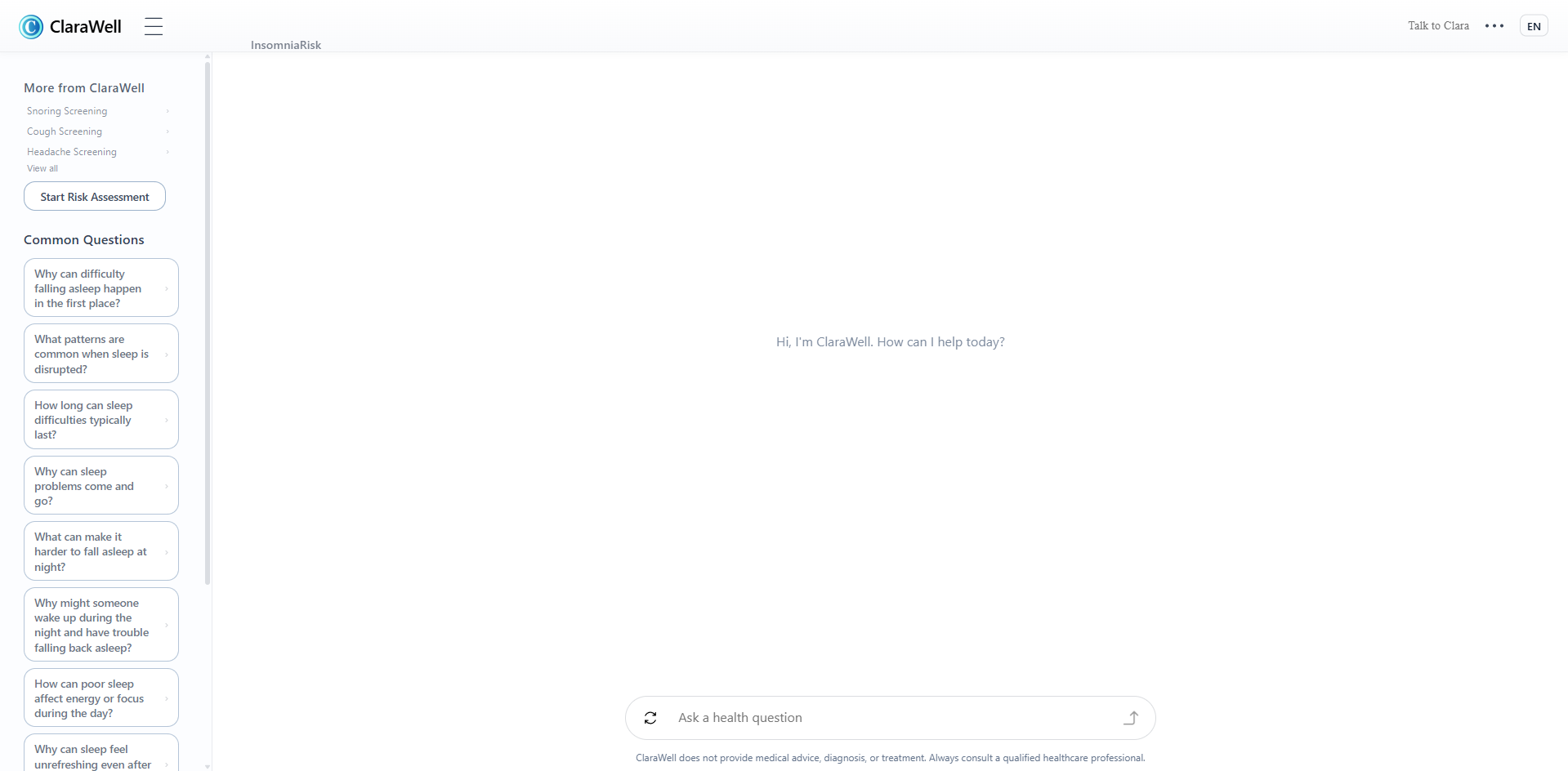
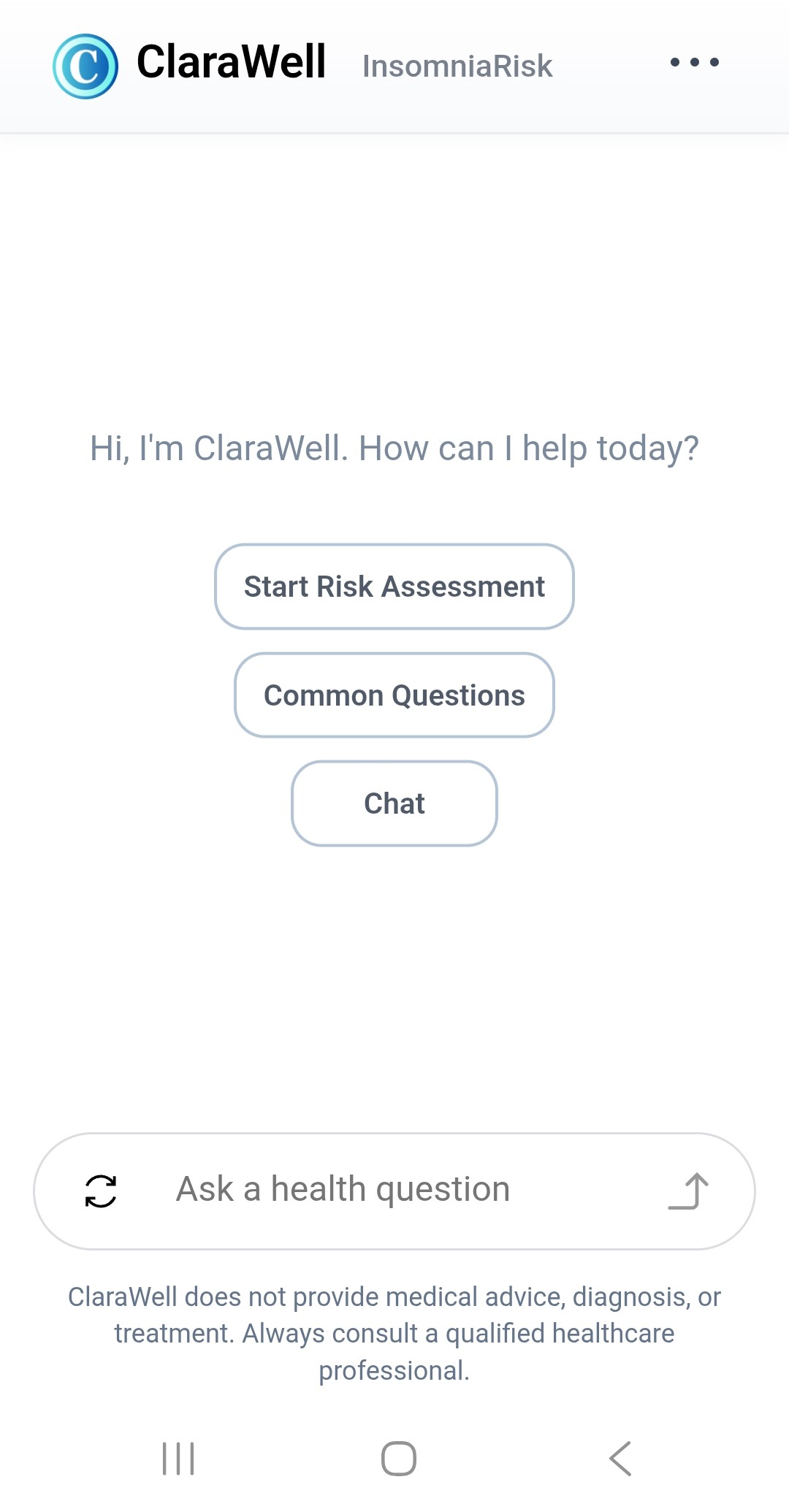
The micro-app owned the topic-specific presentation, guided questions, public copy, and visible interaction flow. It provided the recognizable public entry point for the deployment.
A ClaraWell Health Network surface
By ClaraWell
A focused public experience for understanding sleep difficulty, insomnia-related patterns, general risk context, and the questions people often consider when deciding whether to seek further information or care.
InsomniaRisk began as one of the ClaraWell Health Network's three early public prototypes and operated in that form from April 2025 through April 2026. It later progressed into one of ten completed topic-specific public health deployments. Users simply spoke with ClaraWell. That direct public experience was supported by accessible health information, guided interaction, deterministic governance, and clearly defined non-diagnostic boundaries.

What InsomniaRisk was
InsomniaRisk developed across two public phases: an early prototype operated from April 2025 through April 2026, followed by a completed ClaraWell Health Network deployment.
InsomniaRisk began as one of the ClaraWell Health Network's earliest public prototypes. The prototype remained live from April 2025 through April 2026, giving people a dedicated place to explore difficulty falling asleep, difficulty remaining asleep, early waking, sleep patterns, and frequently raised questions.
Its purpose was to make useful sleep-health information easier to approach while keeping diagnosis, individualized assessment, and treatment decisions with qualified healthcare professionals.
The extended prototype phase provided continuity through a formative period of ClaraWell's public development. It established the topic focus, informational boundaries, interaction patterns, and public identity that later informed the completed InsomniaRisk deployment.
InsomniaRisk subsequently progressed from prototype status into one of ten completed topic-specific ClaraWell Health Network deployments. The later deployment retained the focused sleep-health purpose while operating through ClaraWell's broader conversational, governance, and health-knowledge infrastructure.
The completed deployment combined educational material, guided question pathways, a bounded risk-information experience, and conversational access through ClaraChat. InsomniaRisk presented the topic-specific public surface, ClaraCortex governed runtime execution, and ClaraBrain supplied broader health-knowledge infrastructure.
ClaraCortex applied deterministic interaction and risk boundaries, controlled how the purpose-limited session could proceed, and produced structured governance events that could be reviewed independently of the user-facing interface.
ClaraBrain remained distinct from those governance decisions. It provided broader health knowledge, terminology, and source access while ClaraCortex retained responsibility for the permitted runtime pathway and the application's non-diagnostic boundaries.
InsomniaRisk was an early public expression of composable, governed health intelligence; an architecture designed to coordinate multiple specialized systems into one coherent health experience.
It emerged during a formative period for public Health AI, when the boundaries between conversational systems, health information, governance, and clinical responsibility were still being actively defined.
InsomniaRisk provided a clear public starting point for learning and reflection. It did not establish a diagnosis or replace a clinician, diagnostic test, sleep assessment, or individualized medical evaluation.
Shared system contribution
InsomniaRisk brought together several ClaraWell systems within one bounded public health experience. Each system contributed a clearly defined responsibility: public presentation, conversational access, deterministic governance, or structured health-knowledge support.
The micro-app owned the topic-specific presentation, guided questions, public copy, and visible interaction flow. It provided the recognizable public entry point for the deployment.
ClaraChat presented the guided conversational experience available within InsomniaRisk and carried interaction into the governed runtime while preserving the application's topic and purpose boundaries.
ClaraCortex applied deterministic controls, maintained the bounded risk pathway, and emitted structured governance events so runtime behaviour could be reviewed independently of the public interface.
ClaraBrain provided the broader health-knowledge foundation, terminology, and source access available to ClaraWell systems while remaining separate from runtime governance decisions.
How the experience worked
Across its prototype phase and completed deployment, InsomniaRisk brought several functions together while keeping the user-facing experience focused and understandable.
InsomniaRisk began as a public prototype with one recognizable health topic and a clearly defined informational purpose.
Educational content and common-question pathways helped people move through the subject without requiring an account or an open-ended search process.
The application offered a carefully limited way to consider general symptom and risk context while maintaining a clear distinction between public information and clinical assessment.
ClaraChat provided the visible conversational layer while the exchange remained bounded by InsomniaRisk's topic, application rules, and defined public purpose.
ClaraCortex applied deterministic controls around the session, including route-specific boundaries, bounded risk-state handling, and structured governance events for review.
ClaraBrain supplied broader health knowledge and terminology while remaining separate from both the public interface and the governance rules applied by ClaraCortex.
InsomniaRisk operated without user profiles, patient accounts, or a retained clinical-record relationship. Public interactions were temporary, purpose-limited, and designed without persistent identity.
Privacy and deployment posture
InsomniaRisk was designed for broad public availability without advertising trackers, behavioural profiling, persistent user identifiers, user accounts, or retained clinical records. Its stateless architecture supported deployment across regions while maintaining consistent privacy, governance, and non-diagnostic boundaries.
The public experience was not built around advertising technology, behavioural profiling, or cross-site tracking.
InsomniaRisk required no account, profile, patient identifier, or persistent session identity to access its public information.
Temporary, purpose-limited interactions reduced the need for a retained personal-data relationship and supported a consistent regional deployment posture.
ClaraWell developed the operating posture with applicable privacy and health-information obligations in view, including principles reflected in HIPAA, PIPEDA, and GDPR.
Part of a larger network
The ClaraWell Health Network developed and operated across a 16-month period, beginning with early prototypes in March 2025 and progressing to ten completed public health deployments. An early version of the network was presented at Web Summit 2025.
The ClaraWell Health Network began with three public prototypes: ADHDRisk, ApneaRisk, and InsomniaRisk. InsomniaRisk operated as a public prototype from April 2025 through April 2026 and later progressed to a completed public deployment. ADHDRisk and ApneaRisk remained at the prototype stage.
The network was developed with input from ClaraWell's Medical Advisory Community, including 13 physicians and additional clinical contributors. Individual contributors may be recognized separately where publication permission and historical role details are confirmed.
Each deployment addressed a specific health topic while sharing a common approach to accessibility, privacy, informational boundaries, and governed interaction. Distinct public identities and domains operated on top of shared technical and governance infrastructure.
What public operation established
Across its prototype phase and completed public deployment, InsomniaRisk provided ClaraWell with practical evidence about technical operation, informational boundaries, privacy architecture, governance controls, and controlled system change.
A topic-specific experience can provide a clearer public starting point than a broad and unrestricted health interface.
Runtime boundaries can be defined, versioned, and reviewed outside both the public interface and the systems supplying health knowledge.
Non-diagnostic limits can be expressed directly through public copy, interaction design, routing, and consistent runtime behaviour.
Operating the service publicly involved practical work across availability, routing, runtime behaviour, cost, observability, and controlled infrastructure change.
A useful public health information experience can operate without advertising trackers, persistent identity, accounts, profiles, or a retained patient-data relationship.
When the dynamic service concluded, its design record and operational evidence remained available for reference as we continue developing ClaraWell’s health-intelligence infrastructure.
Current status
InsomniaRisk is preserved here as a static record within the ClaraWell Health Network. Its public prototype operated from April 2025 through April 2026 before progressing to a completed deployment. Its risk-information and conversational functions are no longer active, but this page remains available to document both phases of its public history.
Across both phases, InsomniaRisk created no user account, patient record, or retained personal health-information relationship. The operational knowledge developed through the surface continues within ClaraWell's broader work in governed health intelligence, stateless public health infrastructure, and bounded Health AI deployment.
Static record updated .
Educational context
This preserved page documents a completed public application. It does not provide an active health assessment, diagnosis, medical advice, or treatment direction. Personal health concerns are best discussed with a qualified healthcare professional.
The work established through InsomniaRisk continues across ClaraWell’s governed health intelligence infrastructure. Contact ClaraWell